Press play to listen to this blog.
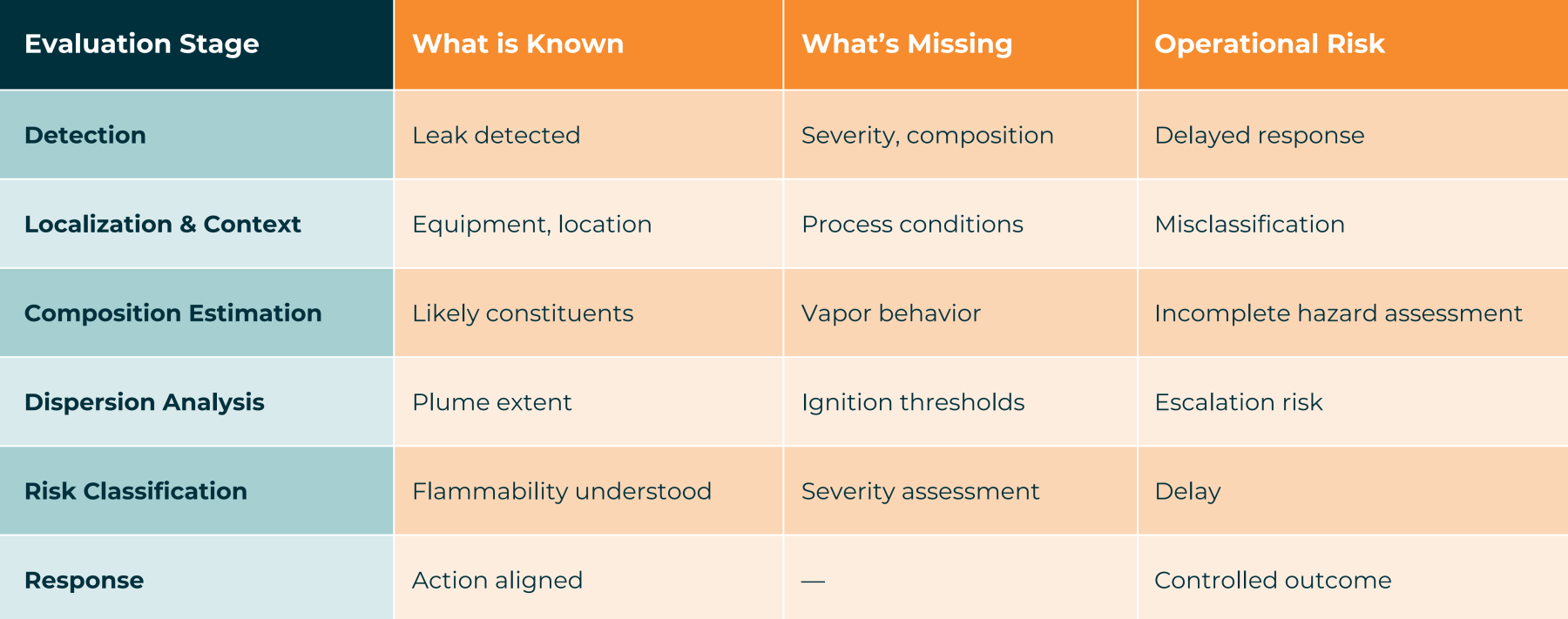
A leak alarm sounds. Operators know something is escaping into the atmosphere. But they may not know what is leaking, how it will disperse, or whether ignition risk is increasing. That uncertainty creates the real operational challenge.
In many industrial facilities, monitoring systems provide the signal, but not the full operational picture. Operators may identify a release point, yet still lack the context needed to assess severity, classify risk, and coordinate response actions quickly.
This creates what many refineries quietly struggle with: the detection-to-decision gap.
Hydrocarbon releases are rarely simple events. Leak behavior depends on composition, operating conditions, temperature, pressure, and weather conditions.
Two leaks may initially appear similar on an alarm dashboard but behave very differently once dispersion and flammability are evaluated.
Traditional leak detection and repair (LDAR) programs remain essential, but alarms alone do not provide enough information for rapid decision-making. A release notification may indicate a leak, but not the operational consequences. In many cases, operators are still navigating with a signal but no map.
An evaluation of five hydrocarbon release scenarios within a naphtha reformer stabilizer system revealed one important insight: composition matters more than location.
Three light hydrocarbon release scenarios containing ethane, propane, and butanes dispersed rapidly under the evaluated conditions and remained below critical flammability thresholds.
Two heavier hydrocarbon release scenarios behaved very differently. In reformate and reboiler scenarios, heavier naphtha-range hydrocarbons generated significantly higher lower flammability limit (LFL) percentages, increasing ignition risk and response urgency.
The findings are operationally significant: a small leak does not automatically mean a small hazard. Initial monitoring identifies the release. Composition and dispersion analysis help determine severity.
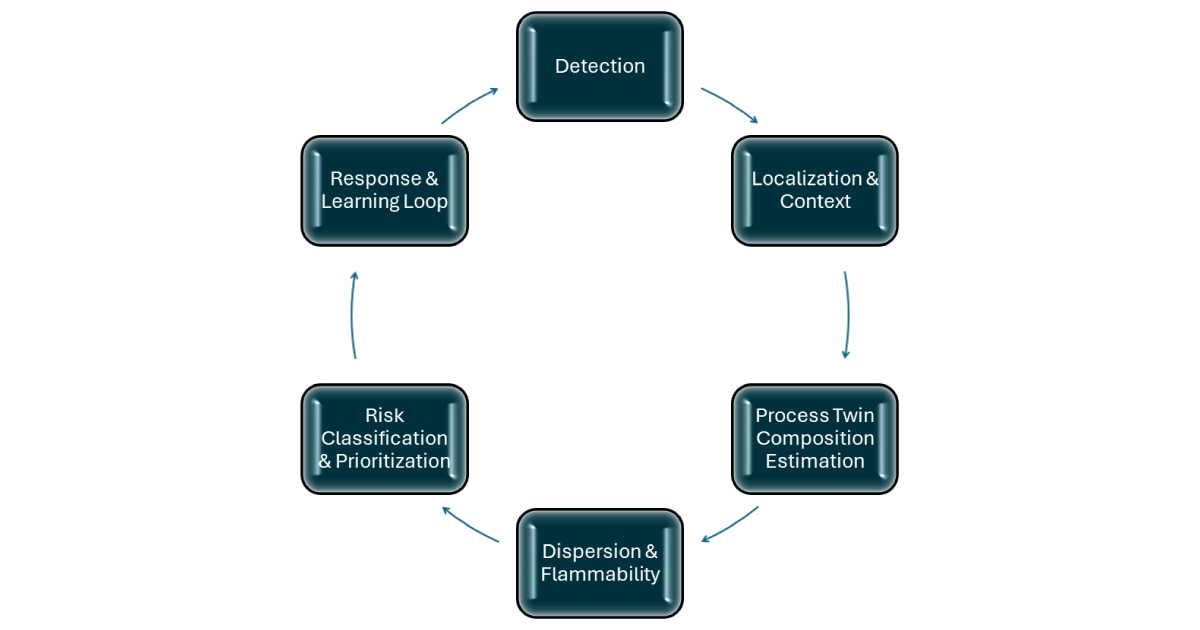
A six-stage digital workflow is designed to help operators move from initial awareness toward informed response. Within this workflow, process twins provide the operational context that monitoring systems alone cannot supply.
Using live operating conditions, the Petro-SIM® process twin estimates likely leak composition immediately following the initial alert. Flaretot® dispersion modeling software then evaluates plume behavior, concentration profiles, and flammability risk under current meteorological conditions.
This helps operators distinguish nuisance releases from credible ignition hazards requiring immediate response.
In many ways, the process twin acts like an industrial flight deck that helps operators interpret fragmented signals, improve visibility, and coordinate response decisions under uncertainty.
Operational response systems are also evolving beyond isolated monitoring tools. AI-enabled orchestration layers could eventually combine drones, robotics, process twins, dispersion modeling, and meteorological data to accelerate hazard assessment in near real time.
AI systems could identify nearby equipment, retrieve operating conditions, estimate leak composition, simulate dispersion behavior, and evaluate flammability risk within minutes.
As industrial systems become increasingly interconnected, the challenge moves beyond identifying abnormal conditions. The challenge is interpreting signals fast enough to support coordinated operational response.
Monitoring technologies alone cannot fully classify operational risk. Without composition insight, dispersion analysis, and operational context, organizations may struggle to understand the severity of a release after the alarm sounds.
Detection provides visibility. Interpretation enables decisions. By integrating process twins, dispersion modeling, and AI-enabled hazard assessment, refiners can improve visibility, accelerate risk evaluation, and strengthen coordinated response during hydrocarbon release events.
For full technical details, case study scenarios, and dispersion modeling results, download the whitepaper: The Detection-to-Decision Gap: Improving Hydrocarbon Release Response Through Process Twins and Dispersion Modeling.