
Press play to listen to this blog.
Hydrogen is scaling fast, and execution is entering a more demanding phase. Projects that look viable in design often prove difficult to operate at scale.
Models must hold under real conditions, where variability, constraints, and system interactions shape performance. Electrolyzers cycle across load ranges and efficiency curves. Storage is finite. Networks impose pressure and flow limits.
The opportunity lies in aligning design with operations. Hydrogen systems must be designed as dynamic, constrained systems, not idealized assets.
Hydrogen projects struggle when early models simplify dynamic systems. Designs rely on steady-state assumptions, fixed efficiencies, and limited operating cases. In practice, renewable input fluctuates. Operating conditions shift across power availability, storage, and network constraints.
These interactions are rarely captured in early models. This leads to rework, cost escalation, and performance gaps. The challenge extends beyond production. It includes how hydrogen is produced, routed, and delivered within real operating constraints.
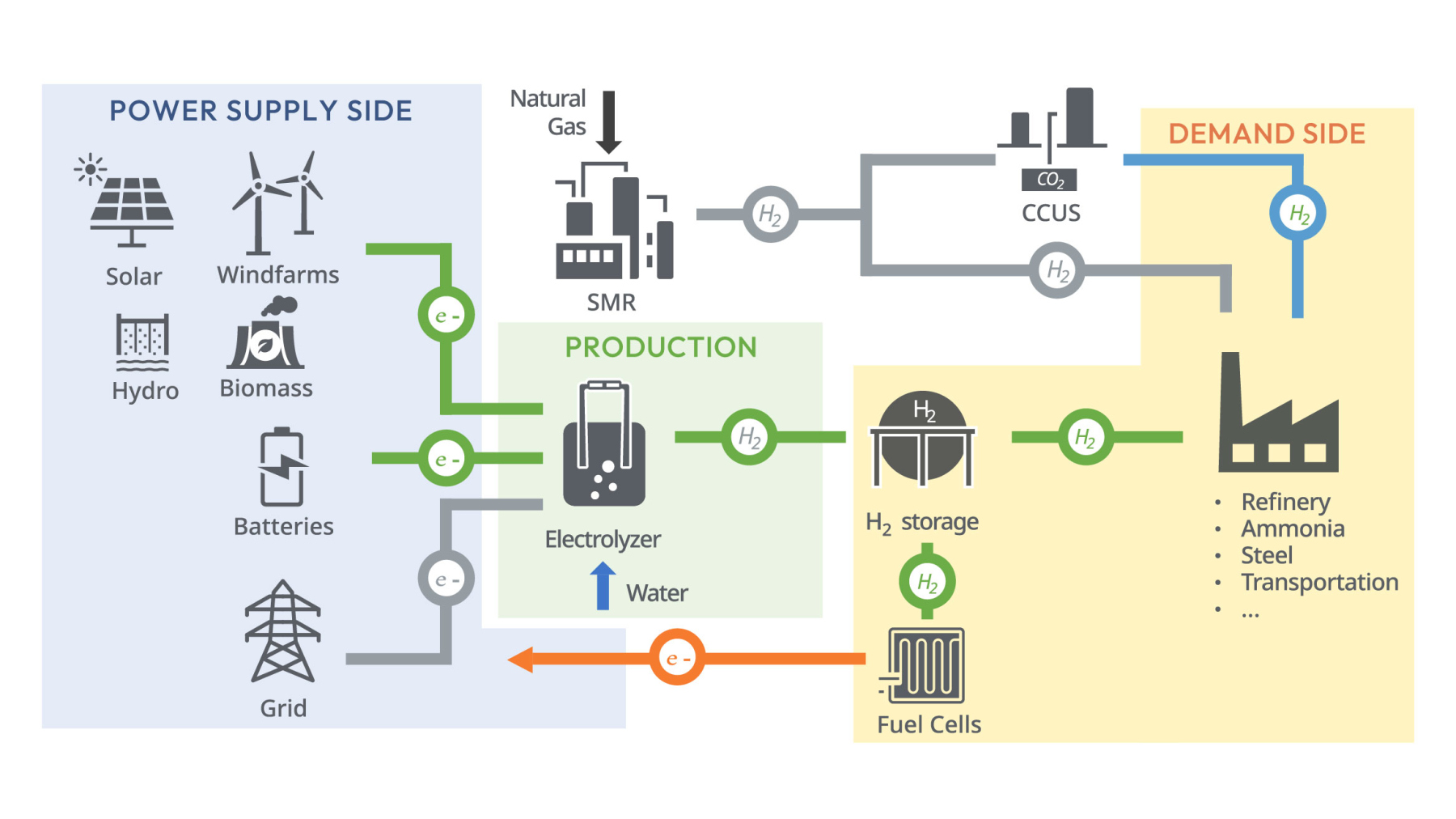
Hydrogen is often framed as a collection of assets. In practice, it operates as an interconnected system.
Power, electrolysis, compression, storage, and demand are tightly linked. Changes in renewable supply shift electrolyzer loading and operating state. That, in turn, impacts efficiency, degradation, and downstream availability.
Storage constraints influence dispatch decisions, while network pressure and flow limits determine whether hydrogen can be physically delivered. These variables are coupled constraints that evolve over time. Treating hydrogen as discrete equipment overlooks system-level hydraulics. Performance depends on system management under constraint, not individual units alone.
Traditional design methods assume stable inputs and predictable operating conditions. Hydrogen systems operate under variable conditions. Renewable power varies. Electrolyzers operate across a wide load range. Efficiency changes with load. Degradation depends on cycling.
Static cases have limited ability to capture this behavior accurately. They miss ramping, cycling, and time-dependent interactions between supply, storage, and demand. This creates gaps in production estimates, mis-sized equipment, and constrained flexibility.
Treating electrolyzer efficiency as constant can overestimate hydrogen production by up to ~20% under realistic operating profiles. Accurate design requires 8760-hour time-series modeling using Petro-SIM® process simulation software across the full system. This technology enables integration of process behavior with system-level constraints.
A decision-grade digital twin links plant data to first-principles models, creating a consistent, physics-based representation of the system.
Visual MESA® Energy Management System extends this foundation by coordinating production, storage, and dispatch across time. It incorporates forecasts for power, demand, and pricing into executable operating decisions.
This shifts hydrogen systems from reactive operation to planned, constraint-aware execution. The result is improved reliability, higher utilization, and performance within real constraints.
Hydrogen performance depends on how well systems are designed for real operation. Variability and constraints are not secondary factors. They define performance.
Designing for steady-state conditions in a dynamic system leads to overbuilt, underutilized, and economically inefficient assets. Advantage comes from designing for how systems behave under constraint. In hydrogen, design sets intent. Operation determines outcome.