
Press play to listen to this blog.
Renewable energy offers clear emissions reduction potential. However, renewable electricity alone cannot fully address system reliability due to variability and uncertainty in power output.
Wind speeds fluctuate. Solar irradiance shifts throughout the day. As penetration increases, variability introduces operational and economic consequences.
Energy storage systems (ESS) have emerged as a key component in enabling a feasible and economically beneficial energy transition.
Renewable systems cannot operate reliably without storage because generation is inherently variable and often misaligned with electricity demand.
Wind output can fall below 10% capacity nearly half the time at a given site. Solar production varies with irradiance and ambient temperature. These fluctuations create imbalance between supply and demand.
The economic impact is measurable. Variability costs for wind increase from $3.75/MWh to $7.87/MWh as penetration rises from 6.8% to 46.8%. Solar PV variability mitigation has been estimated at $8–$11/MWh.
Without storage, systems operate with minimal degrees of freedom and are constrained by real-time source availability. If demand exceeds supply, shutdowns or expensive backup power sources may be required. When supply exceeds demand, generation may be curtailed.
Storage addresses both ends of this imbalance.
Energy storage introduces a buffer between power production and consumption. Instead of sending energy directly from source to sink, storage allows energy to be accumulated when available and released when needed.
This decoupling increases operational degrees of freedom. Operators can determine how much to store, when to store it, and when to discharge it while respecting technical constraints.
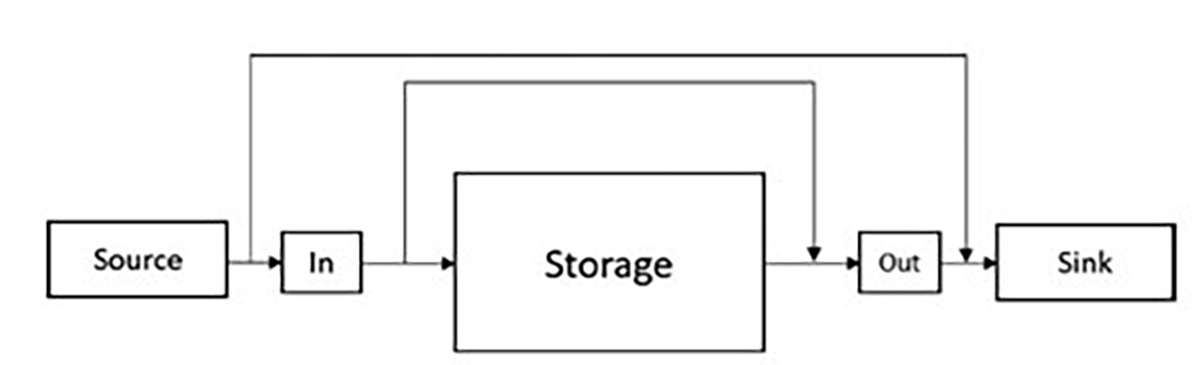
In practical terms, storage enables operators to:
This framework applies across multiple technologies, including electrochemical batteries, hydrogen storage systems, compressed air systems, hydroelectric storage, and gravity-based storage.
Storage is not free. Capital investment scales with capacity. Larger storage can improve operational flexibility but may increase total system cost if capital expenditures outweigh benefits. Thus, correctly sizing storage has a significant impact on site economics.
Flexibility alone does not guarantee value. Effective storage management typically aims to:
Because renewable systems involve variability in generation, demand, and electricity prices, decision-making becomes more complex. Proper management enables feasible operating recommendations that align technical constraints with economic and environmental objectives.
Energy storage plays a critical role in enabling reliable and economically viable renewable systems, particularly when it is both correctly sized and actively managed.
Source
Ruiz, J., Montagna, P., and Wicmandy, M. (2025). “Energy Storage Management.” In Industrial Decarbonization and the Energy Transition: Innovative Solutions for a Carbon-Free, Sustainable, and Clean Environment. Elsevier.