
Press play to listen to this blog.
Process twins are built to represent the refinery. However, that reality shifts over time as feedstock varies, equipment degrades, instruments deviate, and operating conditions change.
These changes don’t invalidate the model. They distort it. Small deviations accumulate until they begin to reflect assumptions rather than reality. Optimization targets move away from true constraints, energy integration becomes less efficient, and planning decisions lose precision.
Many of these models are built on first-principles, physics-based simulation technology such as Petro-SIM®, where accuracy is established but not continuously maintained. By the time this silent drift is visible, optimization is already misaligned with actual constraints.
In many refineries, digital twin maintenance remains manual.
Engineers must:
This takes expertise. It takes time. And, it does not scale. As refineries become more integrated, plant conditions change. Manual recalibration cannot keep pace. Models continue to run, even when they no longer reflect actual plant behavior.
At that point, the issue is operational. Even robust models drift when simulation, planning, and operations are not continuously aligned. What looks like normal variability is often model inaccuracy.
Next-generation digital twins shift from periodic recalibration to continuous lifecycle management. The system monitors model health using prediction accuracy which is based on data quality and calibration history.
The model drifts are combined into a health index. It acts like a pulse check for the model, indicating how closely it reflects real plant behavior. When operating conditions change and the model is no longer representative of the current state, the system triggers alerts that help the user update the model using an automated data analysis, calibration, and tuning workflow.
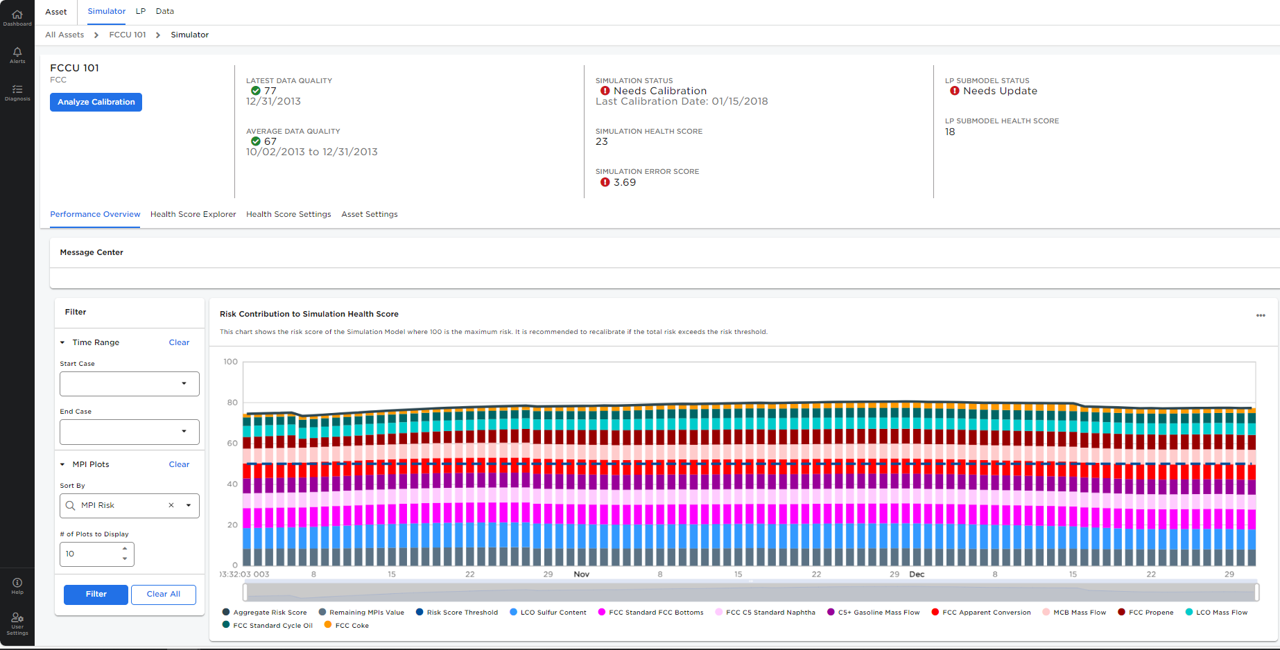
Applications such as the KBC Acuity™ Process Twin Pro synchronize operational data with Petro-SIM process models automatically, creating a continuous feedback loop across planning, scheduling, and operations.
Now, the engineer’s role shifts from model updates to using these models for running sensitivities, maximizing value and decision-making.
Model drift is not a technical issue. It is a performance issue.
Early deployments have shown:
These gains do not come from new models. They come from maintaining alignment between the model and the operation over time.
The most important impact is consistency. Planning and operations rely on the same model. The gap between planned and achievable performance narrows.
Digital twins are evolving from analytical tools into operational systems. Automated lifecycle management keeps models synchronized with real-time conditions, enabling more responsive, data-driven decisions across planning, scheduling, and operations. In this environment, Petro-SIM simulation tools are part of an integrated system.
The shift is simple but profound: digital twins are no longer tools you maintain. They are systems you rely on. That is a step closer to the autonomous refinery. Read the full article.